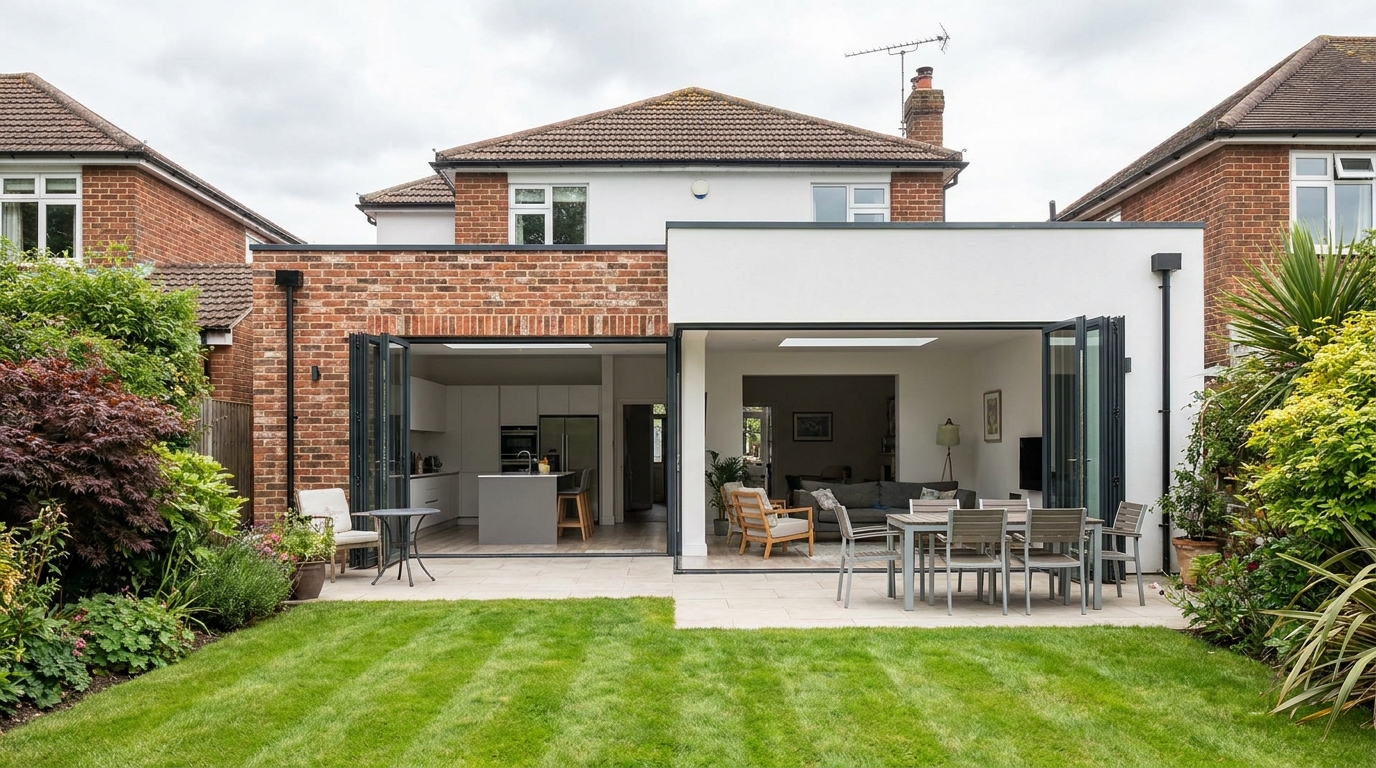
The short answer
Many single-storey rear extensions in England do not need a formal planning application — they fall within permitted development (PD) rights. But double-storey extensions, wrap-arounds and extensions in conservation areas almost always need permission. The rules are set by the Planning Portal and your local authority. See permitted development rules and building regulations, which always apply even when PD covers you.
Permitted development rights allow homeowners to extend their homes without a formal planning application, within limits set by the government. Whether your extension qualifies depends on its size, position, the type of house you have, and whether your property is in a designated area or subject to any conditions that restrict PD rights. The rules changed in 2019 and again subsequently, so checking the current thresholds rather than relying on what a neighbour did ten years ago is essential. This guide sets out the main rules as they stand in England in 2026.
Planning permission for extensions at a glance
- Single-storey rear (detached) Up to 8 m depth — prior approval usually needed
- Single-storey rear (semi/terrace) Up to 6 m depth — prior approval usually needed
- Double-storey rear Up to 3 m depth — strict conditions; usually needs permission
- Side extension Up to half original width if single-storey; conditions apply
- Conservation areas / listed Permitted development rights restricted or removed
- Building regulations Always required regardless of planning position
What are permitted development rights?
Permitted development (PD) rights are a national grant of planning permission for certain types of development, set out in the Town and Country Planning (General Permitted Development) (England) Order 2015 (as amended). They allow you to carry out defined works — including certain extensions — without making a formal planning application to your local planning authority (LPA). The key word is “within the limits”: PD rights only apply when the extension meets all the specified criteria of the relevant permitted development class.
Even where PD applies, you may need to submit a prior approval application to the LPA — this is the “neighbour consultation scheme” for larger single-storey extensions (those between 4–8 m on detached, or 4–6 m on semi-detached and terraced) under Class A(g). The LPA has 42 days to respond; if they do not, you can proceed. A prior approval application is not a full planning application, but it does trigger a consultation with your immediate neighbours.
| Extension type | PD applies if… | Prior approval? |
|---|---|---|
| Single-storey rear (detached) | Up to 4 m depth: automatic PD; 4–8 m: neighbour consultation scheme | Only for 4–8 m range |
| Single-storey rear (semi/terrace) | Up to 3 m: automatic PD; 3–6 m: neighbour consultation scheme | Only for 3–6 m range |
| Side extension (detached) | Single-storey, max half original width, conditions met | No |
| Double-storey rear | Up to 3 m, specific conditions; rarely qualifies in practice | No |
When does PD not apply?
Permitted development rights are removed or restricted in a number of circumstances:
- Conservation areas: PD rights for side extensions are removed in conservation areas; other extensions may also be restricted.
- Listed buildings: listed building consent is required for any works that affect the character of a listed structure; PD rights do not apply.
- Article 4 directions: these are made by the LPA to remove PD rights in specific areas, often to protect the character of an estate or area.
- Original planning conditions: the planning permission under which the house was originally built may include a condition removing all or some PD rights — particularly common on new build estates.
- Volume limits: you must not have used more than 50% of the original garden in total with extensions and outbuildings.
What counts as the “original house”?
For PD purposes, the “original house” means the house as it was built or as it stood on 1 July 1948 (whichever is later). Any extensions added since then count towards the PD volume allowances. If the previous owner added a rear extension, this uses up part of your PD allowance. Always check historical planning records at your LPA if the house has been extended before.
Applying for planning permission
If your extension falls outside PD rights, you need a householder planning application. In 2026 the application fee in England is £258. The LPA has a statutory 8-week target to determine the application (13 weeks for major applications). Success depends on your design meeting the LPA’s local plan policies and national planning policy — a qualified architect who knows the area will improve your chances significantly. See extension without planning permission for what happens if you build without the right consent, and building regulations for the separate compliance requirement that always applies.
This page summarises the rules for England. Different rules apply in Wales, Scotland and Northern Ireland. Always verify your specific planning position with your local planning authority before starting any work.
Frequently asked questions
Do I need planning permission to extend my house in a conservation area?
Your PD rights may be restricted in a conservation area, particularly for side extensions. Always check with your local planning authority before starting work. Most extensions in conservation areas require a full planning application.
What is the neighbour consultation scheme for extensions?
Larger single-storey rear extensions (4–8 m for detached, 4–6 m for semi or terrace) in England can proceed under PD but require a prior approval application to the LPA. Neighbours are consulted for 21 days. The LPA has 42 days to respond.
Can I extend if my neighbour objects?
Objections from neighbours are a material consideration in a planning application, but they are not a veto. For PD prior approval, the LPA considers neighbours’ views but objection alone does not prevent approval. Always be neighbourly: discuss your plans before applying.
Does a planning application guarantee approval?
No. Planning permission is assessed against the local development plan and national policies. There is no guarantee of approval, and refusal is always possible. An architect with local authority experience can advise on the likely outcome before you apply.
Sources & further reading
- Planning Portal — Permitted development rights for householders: interactive guidance (England)
- GOV.UK — Town and Country Planning (GPDO) 2015 and amendments
- GOV.UK — Planning application fees for England (2026)
- LABC — When building regulations approval is required for extensions
This is general information about house extensions in England and is not planning, structural, legal or financial advice. Costs, timescales and outcomes vary with your design, ground conditions, specification and local authority. Always obtain written quotes and verify planning and building regulations requirements with your local planning authority before committing to any works.