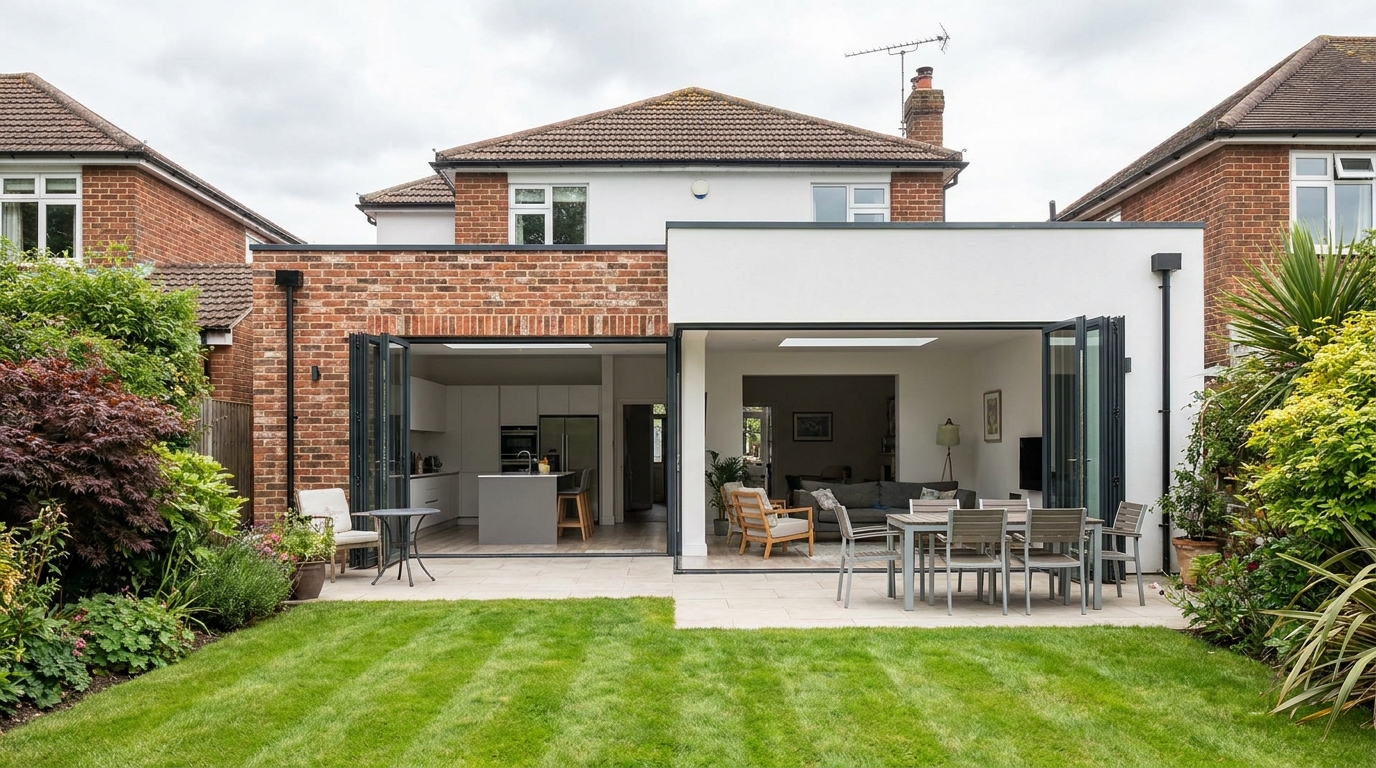
The short answer
A double-storey rear extension typically costs £40,000–£90,000 in the Midlands and North, or £55,000–£120,000 in London and the South East, depending on size and specification. Despite the higher total cost, the cost per m² of added space is often lower than a single-storey because foundations and the ground-floor structure are shared. See the full cost guide and single vs double storey for comparison.
A double-storey extension is a significant investment, but for many families it is the most cost-effective way to add the space they need: two levels of floor space for a relatively modest increase in footprint. Understanding where the money goes — and what genuinely adds value versus what is pure specification choice — helps you make a better decision about scope and budget before you start.
Double-storey extension cost at a glance
- Small (25–35 m² total added) £40,000–£65,000 (Midlands/North)
- Medium (35–50 m² total added) £60,000–£90,000 (Midlands/North)
- London/SE premium Add 25–40% to above figures
- Cost per m² £1,400–£2,500 depending on spec
- Planning permission Almost always required — budget fees
- Professional fees £5,000–£12,000 (arch, SE, planning, BR)
Why double-storey is often better value per m²
The logic of a double-storey extension is that the expensive elements — foundations, ground-floor slab, temporary works, scaffolding, site setup — are shared across two levels of floor space. Building 50 m² of floor space as a double-storey structure costs less per m² than building 50 m² as two separate single-storey extensions, because you only dig the foundations once, erect the scaffolding once and manage the site once. This makes the double-storey extension the most economical way to add significant floor area when your site allows it.
| Project | Approx. cost (Midlands) | Added floor space | Cost per m² |
|---|---|---|---|
| Single-storey 25 m² | £38,000–£48,000 | 25 m² | £1,520–£1,920 |
| Double-storey on same footprint | £55,000–£70,000 | 50 m² | £1,100–£1,400 |
What the build cost covers
A double-storey extension build contract covers:
- Deeper foundations: taking additional structural load, potentially with more complex design if ground conditions are marginal.
- Ground-floor structure: cavity masonry or timber frame with insulation; structural opening into the existing house.
- First-floor deck: timber joists or concrete planks with boarding, forming the ceiling below and floor above.
- First-floor masonry or frame: cavity walls continuing to eaves level with matching or contrasting materials as designed.
- Pitched roof: double-storey extensions almost always use a pitched tiled or slated roof to match or complement the existing house.
- Windows, stairs (if applicable), plumbing and electrics first and second fix.
Additional costs to budget for
Beyond the main build contract, a double-storey project typically involves:
- Architect: £3,000–£7,000 for drawings, planning and contract administration on a domestic double-storey extension.
- Structural engineer: £800–£2,000 for foundations, first-floor deck and beam calculations.
- Planning application fee: £258 (England, 2026 — confirm current rates).
- Building regulations: £600–£1,500 depending on local authority and project value.
- Party wall surveyor: if the extension is near a neighbour’s boundary, allow £700–£2,000 per side.
- Contingency: budget 10–15% over the quoted build cost for unforeseen ground conditions, structural discoveries and changes during the build.
Does a double-storey extension add value?
Adding bedrooms and bathrooms to a property — the typical output of a double-storey extension — can move it into a higher market bracket and add more value than it costs, particularly where the local market supports the higher asking price. However, value is highly location-specific: in areas where comparable properties already sell at a ceiling price, an expensive extension may not fully pay back. See does an extension add value? for the full analysis and how to assess it for your specific property.
All costs on this page are typical illustrations drawn from trade and market data. Your actual costs will vary depending on your design, ground conditions, specification, location and the contractors you select. Always obtain at least three written quotes from builders who have seen your architect’s drawings.
Frequently asked questions
How much more does a double-storey extension cost than single-storey?
In total, typically 60–80% more. But in cost per m² of space added, a double-storey is usually cheaper because the expensive foundation and ground-floor structure elements are shared across two levels.
Can a double-storey extension be permitted development?
Rarely. Double-storey rear extensions are permitted development only up to 3 m depth with strict conditions, and most double-storey projects either exceed this or are on terraced or semi-detached homes where different rules apply. Full planning permission is almost always needed.
How long does a double-storey extension take to build?
On site, typically 14–20 weeks. Add the planning application period (8–13 weeks) and the design and procurement period (8–16 weeks), and the full journey from decision to completion is typically 10–16 months.
What kind of roof does a double-storey extension have?
Almost always a pitched tiled or slated roof to match or complement the existing house. A flat roof on a double-storey extension is less common and rarely accepted in planning terms, as local authorities usually require the extension to be sympathetic to the original building.
Sources & further reading
- RICS — Residential construction cost guidance and building surveys
- LABC — Building regulations for two-storey domestic extensions
- Planning Portal — Permitted development for householders: two-storey extensions (England)
- GOV.UK — Planning application fees and householder application guidance
This is general information about house extensions in England and is not planning, structural, legal or financial advice. Costs, timescales and outcomes vary with your design, ground conditions, specification and local authority. Always obtain written quotes and verify planning and building regulations requirements with your local planning authority before committing to any works.