The short answer
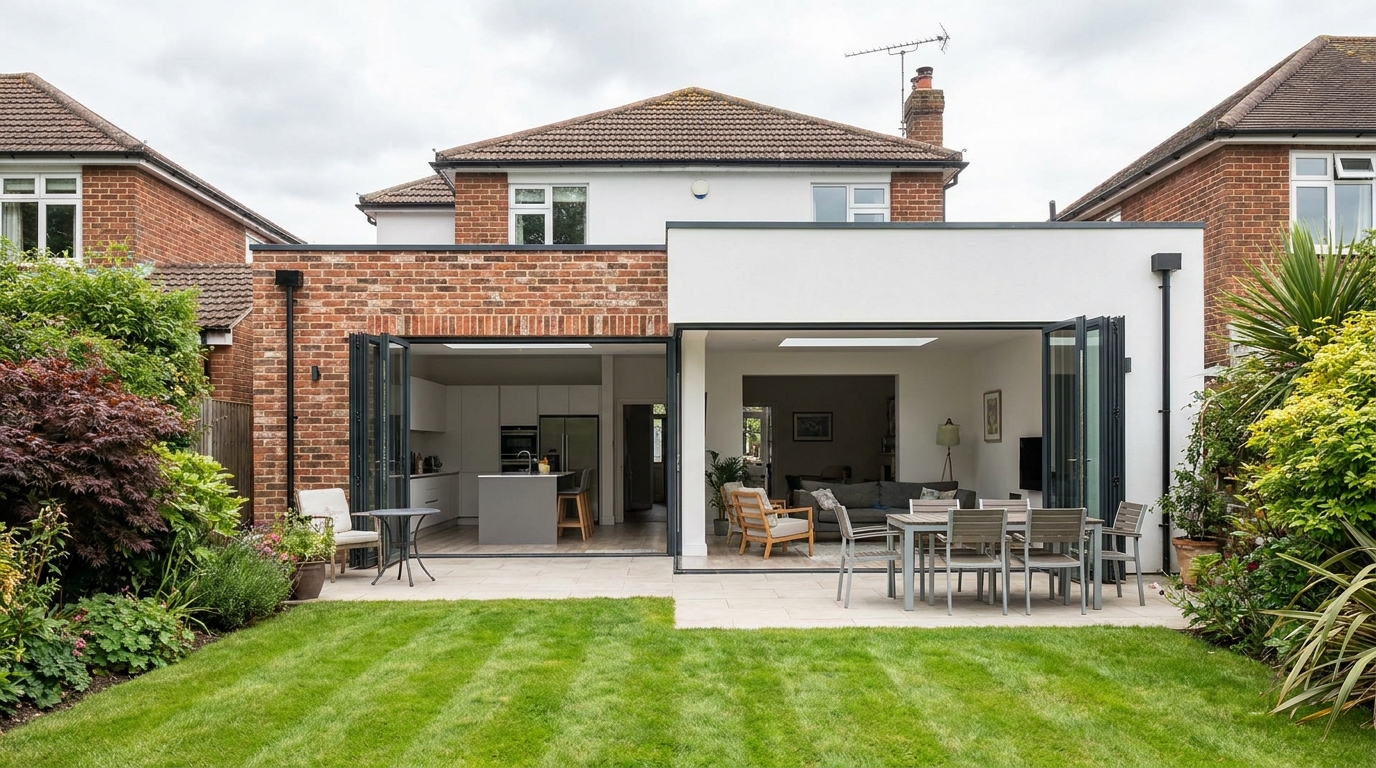
Permitted development allows many single-storey rear extensions without a formal planning application, but strict size and condition limits apply. Detached houses can extend up to 8 m to the rear; semi-detached and terraced up to 6 m (both under prior approval). Double-storey extensions have tighter rules and rarely qualify. See do I need planning permission? and building regulations which always apply.
Permitted development (PD) rights for house extensions are set by the Town and Country Planning (General Permitted Development) (England) Order 2015 and subsequent amendments. The rules are more detailed than most guides suggest, and the difference between a project that qualifies and one that does not can be a matter of centimetres or a single condition. This guide works through the main rules for Class A (enlargement of a dwelling) as they apply in 2026 in England.
Permitted development rules at a glance
- Single-storey rear (detached) Max 8 m depth; 4 m eaves height; prior approval 4–8 m
- Single-storey rear (semi/terrace) Max 6 m depth; 4 m eaves height; prior approval 4–6 m
- Double-storey rear Max 3 m depth; at least 7 m from rear boundary; no balconies
- Side extension Single-storey; max half original width; 4 m eaves height
- Height Max 4 m eaves height; not higher than existing roof
- Restrictions Conservation areas, listed buildings, Article 4 — check first
Class A: the rules for extending a house
Most residential extension PD rights fall under Class A (Development within the curtilage of a dwellinghouse) of Schedule 2, Part 1 of the GPDO 2015. To benefit from Class A PD, your extension must meet all the conditions simultaneously — it is not a menu of options. The key criteria are:
- Volume: you must not exceed the volume of the original house by more than 50% (or 115 m³ whichever is greater for a terraced house) in aggregate across all extensions and outbuildings.
- Height: a single-storey extension cannot exceed 4 m eaves height and must not be higher than the highest part of the existing roof. A two-storey extension cannot be more than 3 m above the eaves of the existing roof.
- Rear extension depth: single-storey maximum 4 m (detached) or 3 m (semi/terrace) without prior approval; 8 m (detached) or 6 m (semi/terrace) with prior approval under the neighbour consultation scheme.
- Side extensions: must be single-storey, must not exceed half the width of the original house, and may not be within 1 m of the boundary on the side where the extension is being built in certain circumstances.
- Materials: external materials must be similar in appearance to those used on the existing house.
| Criterion | Detached house | Semi-detached / Terraced |
|---|---|---|
| Max depth (automatic PD) | 4 m | 3 m |
| Max depth (prior approval) | 8 m | 6 m |
| Max eaves height (single-storey) | 4 m | 4 m |
| Side extension max width | Half original width | Half original width |
| Double-storey max depth | 3 m | 3 m |
The neighbour consultation scheme (prior approval)
For extensions between 4–8 m (detached) or 4–6 m (semi/terrace), you must submit a prior approval application to the LPA. This is not a full planning application; the LPA considers only the impact on the amenity of neighbouring properties. Neighbours are consulted for 21 days. If no objections are raised or the LPA does not object within 42 days, you can proceed. The LPA may impose conditions. The application form and process are simpler than a full householder application, and the fee is £120 as at 2026 (confirm current rates with your LPA).
Class A conditions: things that can catch you out
Beyond size limits, Class A PD comes with conditions that must all be met:
- No extension at the front of the house (the principal elevation).
- No side extensions with upper-floor windows facing the neighbour unless more than 1.7 m above the finished floor level.
- No balconies, verandas or raised platforms (Juliet balconies at first-floor level in a double-storey extension are excluded).
- The extension must not project beyond the principal elevation or a side elevation facing a highway.
- In a conservation area, no side or rear extensions from the principal elevation forward.
Lawful development certificates
Even when your extension clearly qualifies as PD, it is worth considering a Lawful Development Certificate (LDC) from the LPA. This is a formal written confirmation that the works are lawful. It is not mandatory, but it removes future doubt — particularly useful when selling the property, when a buyer’s solicitor asks for evidence of planning compliance. The LDC application fee is £120 (2026 England rate — confirm current figure with your LPA). An architect can advise on whether an LDC is worthwhile in your situation.
This page summarises the rules for England in 2026. Rules differ in Wales, Scotland and Northern Ireland, and in listed buildings, conservation areas and properties subject to Article 4 directions. Always verify the current rules with your local planning authority before starting any work.
Frequently asked questions
Can I build a single-storey extension without planning permission?
Often yes, in England, if the extension falls within permitted development limits. For a detached house, up to 8 m depth to the rear is possible under the neighbour consultation scheme. Rules vary by house type and location — always check before starting.
What is a Lawful Development Certificate?
An LDC is formal written confirmation from the local planning authority that your works are lawful under permitted development rights. It is not required, but it is useful evidence when selling the property and removes doubt about planning compliance.
Do PD rules apply to flats or maisonettes?
No. Permitted development rights for extensions under Class A apply only to dwellinghouses. Flats and maisonettes have no equivalent PD rights for external alterations and extensions; a planning application is always required.
What happens if I build outside permitted development limits?
Building outside PD limits without planning permission is a breach of planning control. The LPA can require you to remove or alter the extension within four years of completion. See our guide on extension without planning permission risks for the full consequences.
Sources & further reading
- Planning Portal — Permitted development rights for householders: technical guidance (England)
- GOV.UK — Town and Country Planning (GPDO) 2015 and subsequent amendments
- GOV.UK — Lawful development certificates: guidance for applicants
- LABC — Building regulations for householder extensions and when approval is required
This is general information about house extensions in England and is not planning, structural, legal or financial advice. Costs, timescales and outcomes vary with your design, ground conditions, specification and local authority. Always obtain written quotes and verify planning and building regulations requirements with your local planning authority before committing to any works.