The short answer
A rear extension extends the back of the house into the garden; a side return extension fills in the narrow side passage that runs alongside many Victorian and Edwardian terraces. Both can be combined in a wrap-around extension. The right choice depends on your garden size, your site layout and what space you need. See extension costs for typical prices.
The majority of ground-floor extension projects on terraced and semi-detached houses involve either extending to the rear, filling in the side return, or both. Each addresses a different problem: a rear extension deepens the living space; a side return extension widens a narrow kitchen or creates a utility room. Understanding the difference — and which is more appropriate for your specific home — is the starting point for any extension design brief.
Rear vs side return at a glance
- Rear extension Extends depth; enlarges kitchen, dining or living
- Side return Fills side passage; widens ground floor
- Rear typical cost £20,000–£50,000 for a standard project
- Side return typical cost £15,000–35,000 for a standard project
- Wrap-around (both) £50,000–£120,000 combining both
- Planning Both often PD for single-storey; check thresholds
What a rear extension delivers
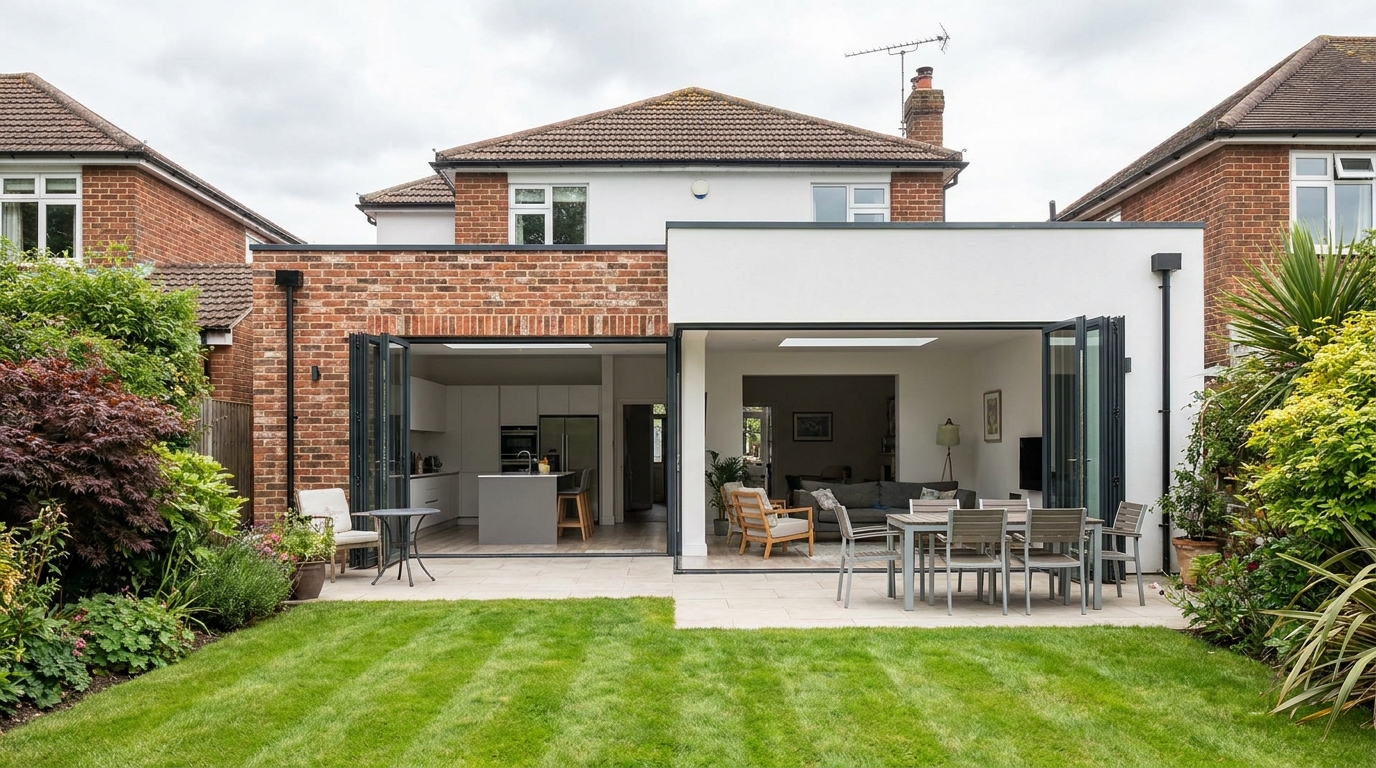
A rear extension adds floor space by pushing the building line further into the garden. The result is a deeper ground-floor room — typically a larger kitchen, a dedicated dining area, or an open-plan kitchen-dining-living space. For properties where the kitchen is already an adequate width but is simply too short, a rear extension is the natural solution. It is also effective for creating a ground-floor bedroom or bathroom on a single-storey addition, or adding two levels of space in a double-storey project.
The main constraint on a rear extension is the garden: the deeper you extend, the more outdoor space you lose. Local planning authorities typically consider the impact on garden space and natural light for neighbouring properties. A 4–6 m single-storey rear extension is the most common footprint because it stays within typical permitted development limits and preserves a usable garden. See permitted development rules for the size thresholds in England.
What a side return extension delivers
A side return extension fills in the L-shaped passage that runs alongside many Victorian and Edwardian terraced and semi-detached houses — the narrow strip between the back of the main house and the garden, typically 1–2.5 m wide and running the length of the rear reception rooms. The result is not extra depth, but extra width. This can transform a narrow, dark kitchen from a galley into a generous room, or create a new utility, boot room or WC alongside the kitchen. The ceiling is typically glazed, or a rooflight installed, to bring light into what was a dark external passage.
| Factor | Rear extension | Side return extension |
|---|---|---|
| Space added | Depth (longer room) | Width (wider room) |
| Garden used | Yes — extension footprint | Only the side passage |
| Light strategy | Rear glazed wall / doors | Overhead glazing typical |
| Typical cost | £20,000–£50,000 | £15,000–£35,000 |
| Planning (PD, single-storey) | Often permitted development | Often PD (detached); check for semi/terrace |
| Party wall? | Possibly (if near boundary) | Very likely (works near or on boundary) |
The wrap-around: combining both
The most dramatic ground-floor transformation combines a rear extension and a side return in an L-shaped wrap-around extension. This creates a single large open-plan space running the full width and the extended depth of the house. It is the most expensive single-storey option, almost always needs planning permission, and involves the most structural complexity — but it transforms a narrow, segmented Victorian ground floor into a contemporary open space in a way that neither a rear extension nor a side return alone achieves.
Which is right for your home?
The answer depends on your specific layout. Measure your existing kitchen width and depth. If the room is too narrow but an adequate length, a side return solves the problem. If it is wide enough but too short, a rear extension is the solution. If it is both narrow and too short, consider the wrap-around. A brief conversation with an architect who has visited the house will clarify the options quickly. See do I need an architect? and how to choose a builder for the next steps.
This page is general information about ground-floor extension types in England. Planning rules, costs and outcomes vary by location and property type. Always check with your local planning authority and obtain professional advice before starting any works.
Frequently asked questions
Which is cheaper, a rear extension or a side return?
A side return extension is typically cheaper because it fills a smaller footprint (the existing passage) rather than taking new garden space. A standard side return might cost £15,000–£35,000 versus £20,000–£50,000 for a rear extension of similar floor area.
Do I need planning permission for a side return extension?
Possibly not, if it is single-storey and meets permitted development conditions on a detached house. On a terraced or semi-detached house, PD rights for side extensions are more restricted and a planning application is more likely to be needed. Always check with your local authority.
Can I combine a rear and side return extension?
Yes — this is called a wrap-around extension and is the most dramatic ground-floor transformation. It is more complex and expensive, and almost always requires full planning permission, but it delivers the maximum possible open-plan ground-floor space.
What is a side return on a house?
A side return is the narrow L-shaped passage that runs alongside the rear section of many Victorian and Edwardian terraced and semi-detached houses, between the back of the main building and the side boundary. It is typically 1–2.5 m wide and open to the sky, making it a natural infill opportunity.
Sources & further reading
- Planning Portal — Permitted development rights for householders: extensions and side additions
- LABC — Building regulations for single-storey extensions and infill additions
- Party Wall etc. Act 1996 — Rights and obligations for works near boundaries
- RICS — Residential building surveys and structural assessments for side extensions
This is general information about house extensions in England and is not planning, structural, legal or financial advice. Costs, timescales and outcomes vary with your design, ground conditions, specification and local authority. Always obtain written quotes and verify planning and building regulations requirements with your local planning authority before committing to any works.