The short answer
The main types are rear extension, side extension, double-storey extension, wrap-around extension and over-garage extension, each suited to different homes and needs. Choice depends on your site, budget and planning position. A wrap-around extension delivers the most ground-floor space; a double-storey gives the most volume for the footprint.
No two houses or gardens are the same, which is why the right type of extension varies so much from one property to the next. The type you choose determines not only what you get in terms of space, but also which planning rules apply, what the project costs, and how long it takes to build. Understanding the options before you appoint an architect or designer means you brief them more clearly and get a better result. This guide runs through all the main types with their practical implications.
Extension types at a glance
- Rear extension Most common — enlarges kitchen, dining or living space
- Side extension Uses the side return or passage; widens ground floor
- Double-storey Two levels; adds most volume per footprint
- Wrap-around Rear + side combined; maximum ground-floor space
- Over-garage Adds first-floor space above integral or attached garage
- Planning Each type has different PD thresholds — check before designing
Rear extension
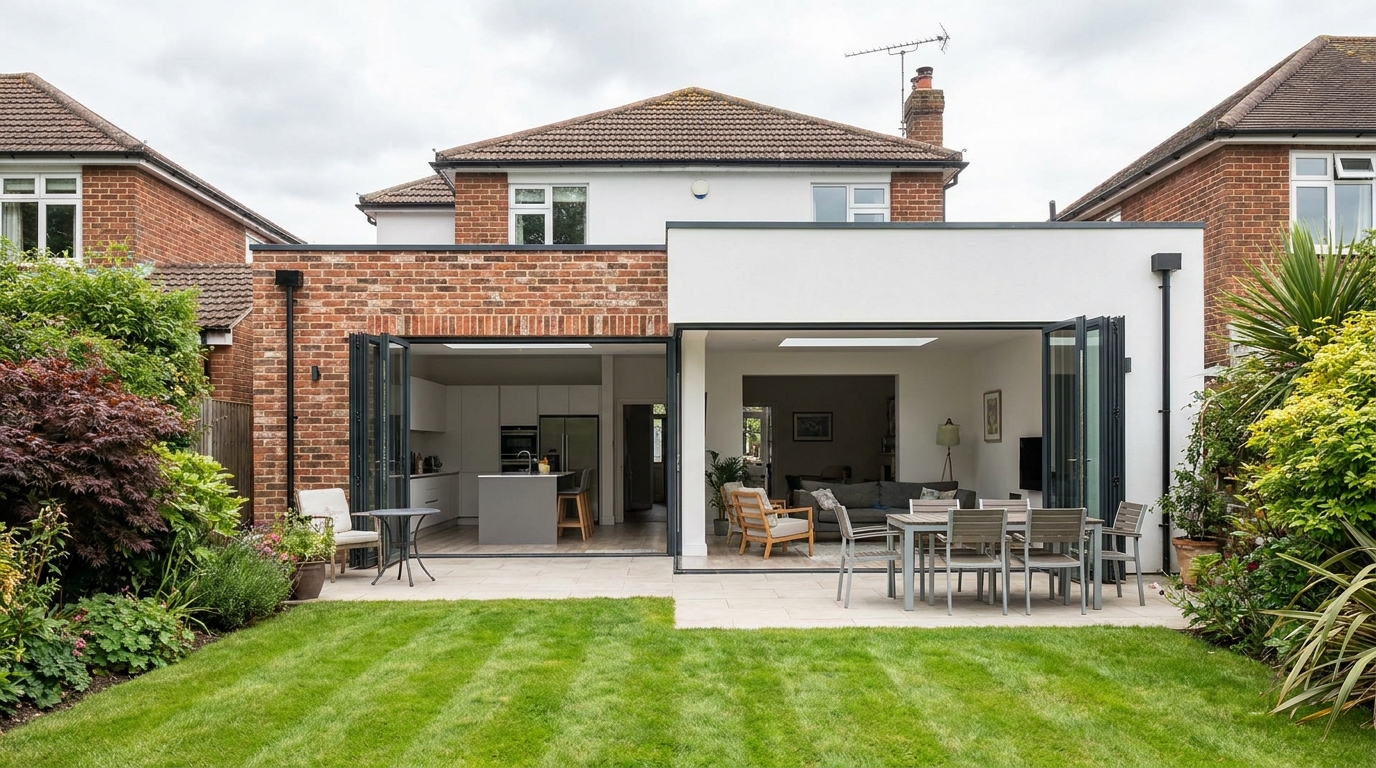
The rear extension is the most common type: the house is extended out towards the back garden. It typically creates a larger kitchen, an open-plan kitchen-dining area, or a ground-floor family room. Single-storey rear extensions benefit most from permitted development rights — in England a detached house can extend up to 8 metres from the original rear wall under prior approval, a semi-detached or terraced house up to 6 metres — making them the path of least planning resistance. The depth you can achieve determines the size of room you get, and the rear wall of the house typically becomes largely glazed to bring light into the new space.
Side extension
A side extension is built into the side return — the narrow passage alongside a Victorian or Edwardian terrace — or, for a detached house, onto the side elevation. It is particularly effective in homes where the kitchen is narrow because of the traditional layout: pushing out to the side can double the width of the ground floor. Side extensions on detached houses can be permitted development if they are single-storey, less than half the width of the original house and meet other conditions. On semi-detached or terraced properties, a side extension almost always requires a planning application. A party wall agreement is often needed where the extension is near or on the boundary.
Double-storey extension
A double-storey extension adds floor space on two levels — typically a new ground-floor room and a bedroom and/or bathroom above. It delivers the most total volume per unit of footprint and is often the most cost-effective way to add significant space, because the foundations, ground-floor structure and much of the substructure cost is shared between the two floors. Almost all double-storey extensions require full planning permission; the rules are tighter because of the greater impact on neighbours’ light and privacy. See double-storey extension cost for typical figures.
Wrap-around extension
The wrap-around extension combines a rear extension and a side extension in an L-shape, covering both the side return and the rear of the property in a single build. It is the most dramatic ground-floor transformation available to a Victorian or Edwardian terrace, often opening the entire back of the house and the side return into one large open-plan space. Because it combines two extension types, it is also the most complex to plan and build, and virtually always requires a full planning application. The structural engineer’s input is significant, particularly at the junction of the two wings.
| Extension type | Best for | Planning permission usually |
|---|---|---|
| Single-storey rear | Kitchen, dining, family room | Often PD (prior approval) |
| Side / side return | Wider kitchen, utility | Often PD (detached); often needed (semi/terrace) |
| Double-storey | Bedrooms + bathrooms | Usually required |
| Wrap-around | Open-plan ground floor | Usually required |
| Over-garage | Bedroom or home office | Varies by situation |
Over-garage extension
Where a house has an integral or attached single garage, building above it can be a relatively affordable way to add a bedroom, bathroom or home office. The existing garage structure may need to be strengthened to take the extra load — this is the key structural question — and planning rules vary. If the garage is attached to the side of the house and the extension brings the height to match the main roof, it can sometimes be permitted development, but in practice many over-garage extensions need a planning application because of the visual impact on the street scene. A structural engineer should assess the existing garage structure before any design work is finalised.
Which type is right for your home?
The right type depends on your site (garden size and orientation, side return availability), your planning position (PD rights or conservation area restrictions), your budget and the space you actually need. An architect who is familiar with your house type — whether it is a Victorian terrace, 1930s semi or modern detached — can advise quickly on which types are viable and which would likely be refused. See do I need an architect for an extension? and how to choose a builder for the next steps.
This page is general information about extension types in England. Planning rules differ in Wales, Scotland and Northern Ireland, in conservation areas, for listed buildings and where Article 4 directions remove PD rights. Always verify your position with your local planning authority before starting.
Frequently asked questions
What is the most popular type of house extension?
Single-storey rear extensions are the most common, primarily because they often fall within permitted development and are the most straightforward to build. They typically extend the kitchen and dining area.
What type of extension adds the most value?
A double-storey extension that adds bedrooms tends to add the most absolute value, as it can move the property into a higher price bracket. However, value is always location-dependent and should be assessed by an RICS surveyor.
What is a wrap-around extension?
A wrap-around extension combines a rear extension and a side return extension in an L-shape, creating the maximum possible ground-floor open-plan space. It is the most complex and usually most expensive ground-floor option.
Do I need planning permission for any type of extension?
It depends on the type, size and your property. Single-storey rear extensions often qualify as permitted development; double-storey and wrap-around extensions almost always need full planning permission. See our planning permission guide for the rules.
Sources & further reading
- Planning Portal — Permitted development rights for householders: extensions and additions (England)
- LABC — Building regulations for extensions: structural, fire and energy guidance
- RICS — Residential building surveys and valuation for extended properties
- Party Wall etc. Act 1996 — Rights and obligations for work at or near boundaries
This is general information about house extensions in England and is not planning, structural, legal or financial advice. Costs, timescales and outcomes vary with your design, ground conditions, specification and local authority. Always obtain written quotes and verify planning and building regulations requirements with your local planning authority before committing to any works.